 Amar
Amar 
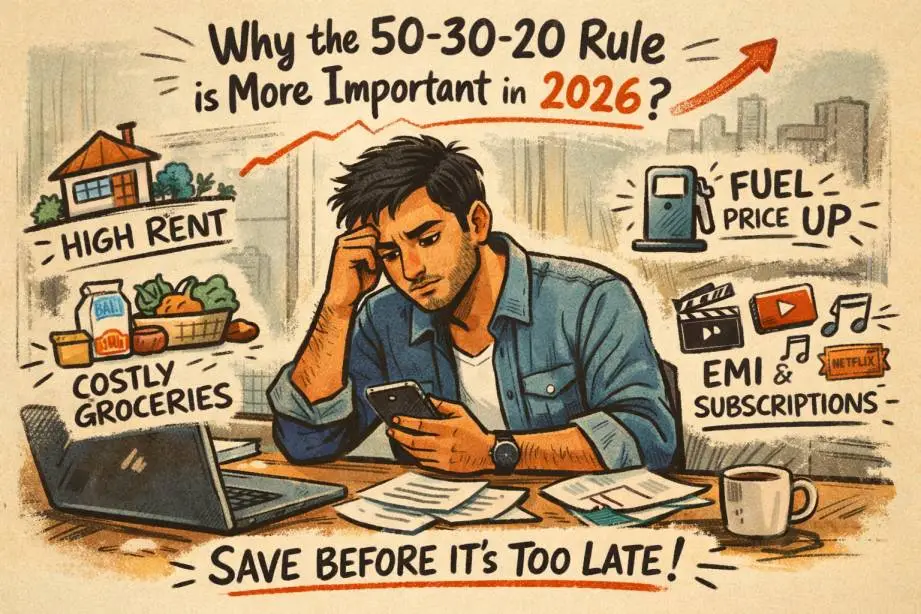
In 2026, earning money is no longer the biggest challenge, but Managing money is.
Salaries have increased compared to previous years. digital payments everywhere, google pay, phone pay, paytm etc., Credit is easily available. Lifestyle options have multiplied. Yet despite all this, the most people feel stressed.
Ask a simple question to a working professional in india today. “If you lose your job tomorrow, how long can you survive without income?”
For many, the honest answer is less than three months.
This is not because people are careless, it is because of the cost of living has quietly outpaced income growth, while lifestyle expectations have risen faster than financial awareness.
There is where an old but powerful budgeting concept becomes more relavant than ever:
Now you have a question, What is 50-30-20 rule and why to much in important in our life? then 1st we see what is 50-30-20 rule.
What is the 50-30-20 Rule?
The 50-30-20 rule is a basic budgeting framework that divides your after-tax income into three parts:
50% for Needs
Essential expenses you cannot avoid.
30% for Wants
Lifestyle choices and non-essential spending.
20% for Savings & Investments
Your future financial security.
This rule is not about becoming rich quickly.
it is about avoiding financial stress and building long-term stability.
Understanding Each Component in Detail
50% for Needs-Your Survival Expenses
Needs are expneses without which daily life cannot function.
In India, these typically include:
- House rent or home loan EMI
- Groceries and daily food
- Electricity, water, gas bills
- Basic mobile and internet plans
- Transportation (fuel, public transport)
- School or college fees
- Health insurance premiums
- Minimum loan EMIs
Important point:
If an expense feels painful but unavoidable, it is probably a need.
30% for wants- Your Lifestyle Choices
Wants are expenses that improve comfort but are not essential for survival.
- Eating out and food delivery apps
- OTT subscriptions
- Shopping for fashion and gadgets
- Travel and vacations
- Upgrading phones frequently
- Gym memberships beyond basic health needs
- Entertainment and hobbies
In 2026, wants have become “invisible expenses” due to digital payments and subscriptions.
20% for Savings – Paying Your Future First
This is the most neglected part of modern personal finance.
Savings include:
- Emergency fund
- SIPs in mutual funds
- Fixed deposits
- PPF, NPS
- Term insurance
- Skill development investments
This 20% is not optional.
It is non-negotiable self-respect money.
Why the 50-30-20 Rule Is More Important in 2026
1. Inflation Is Quietly Destroying Purchasing Power
Inflation in India may not always look scary on paper, but its real impact is brutal.
- Rent has increased sharply in cities.
- Education and healthcare costs are rising faster than income.
- Food inflation fluctuates but trends upward over time.
If your salary increases by 8–10% but expenses rise by 12–15%, you are actually becoming poorer.
The 50-30-20 rule forces discipline before lifestyle inflation takes over.
2. Invisible EMIs Have Replaced Traditional Loans
Earlier, EMIs meant home loans or car loans.
In 2026, EMIs look like:
- Buy Now Pay Later (BNPL)
- Credit card minimum dues
- No-cost EMIs on gadgets
- Subscription-based services
These small monthly deductions do not feel painful individually, but together they silently eat your savings.
The 50-30-20 rule exposes this problem clearly.
3. Job Security Is Weaker Than Ever
The idea of a stable, lifelong job is fading.
- AI automation
- Contract-based employment
- Freelancing and gig work
- Frequent layoffs
In such a world, an emergency fund is not a luxury—it is survival capital.
The 20% savings rule ensures you build this buffer consistently.
4. Retirement Is Now a Self-Managed Responsibility
1. Inflation Is Quietly Destroying Purchasing Power
Inflation in India may not always look scary on paper, but its real impact is brutal.
- Rent has increased sharply in cities.
- Education and healthcare costs are rising faster than income.
- Food inflation fluctuates but trends upward over time.
If your salary increases by 8–10% but expenses rise by 12–15%, you are actually becoming poorer.
The 50-30-20 rule forces discipline before lifestyle inflation takes over.
2. Invisible EMIs Have Replaced Traditional Loans
Earlier, EMIs meant home loans or car loans.
In 2026, EMIs look like:
- Buy Now Pay Later (BNPL)
- Credit card minimum dues
- No-cost EMIs on gadgets
- Subscription-based services
These small monthly deductions do not feel painful individually, but together they silently eat your savings.
The 50-30-20 rule exposes this problem clearly.
3. Job Security Is Weaker Than Ever
The idea of a stable, lifelong job is fading.
- AI automation
- Contract-based employment
- Freelancing and gig work
- Frequent layoffs
In such a world, an emergency fund is not a luxury—it is survival capital.
The 20% savings rule ensures you build this buffer consistently.
4. Retirement Is Now a Self-Managed Responsibility
For most private-sector employees in India:
- No guaranteed pension
- Limited employer support
- Rising post-retirement healthcare costs
If you do not save today, your future self will pay the price.
Step-by-Step Guide to Implement the 50-30-20 Rule in 2026
Step 1: Calculate Your After-Tax Income
Use only the money you actually receive.
Step 2: Track Spending for 30 Days
UPI and card statements are enough.
Step 3: Categorize Expenses Honestly
No emotional justifications.
Step 4: Automate Savings
SIP on salary day.
Step 5: Adjust Lifestyle Gradually
Do not cut everything at once.
Written by a personal finance writer focused on Indian middle-class money challenges, inflation impact, and practical budgeting strategies.
Is the 50-30-20 rule still relevant in 2026?
Yes. In fact, it is more relevant due to rising inflation, job uncertainty, and lifestyle inflation.
Can the 50-30-20 rule work with a low salary?
Yes. You can modify it to 60-30-10 temporarily, but savings should never be zero.
Does the rule include investments or only savings?
The 20% includes both savings and investments like SIPs, PPF, and emergency funds
Is this rule suitable for freelancers?
Yes. Freelancers should prioritize savings even more due to irregular income.
What if my needs exceed 50%?
Reduce wants first. If unavoidable, increase income or temporarily adjust the ratio.


